







Rectifier Diodes for Wireless Power Transfer
– To Realize a True Wireless Society –Connect Everything Wirelessly, Volume 6
– To Realize a True Wireless Society –Connect Everything Wirelessly, Volume 6
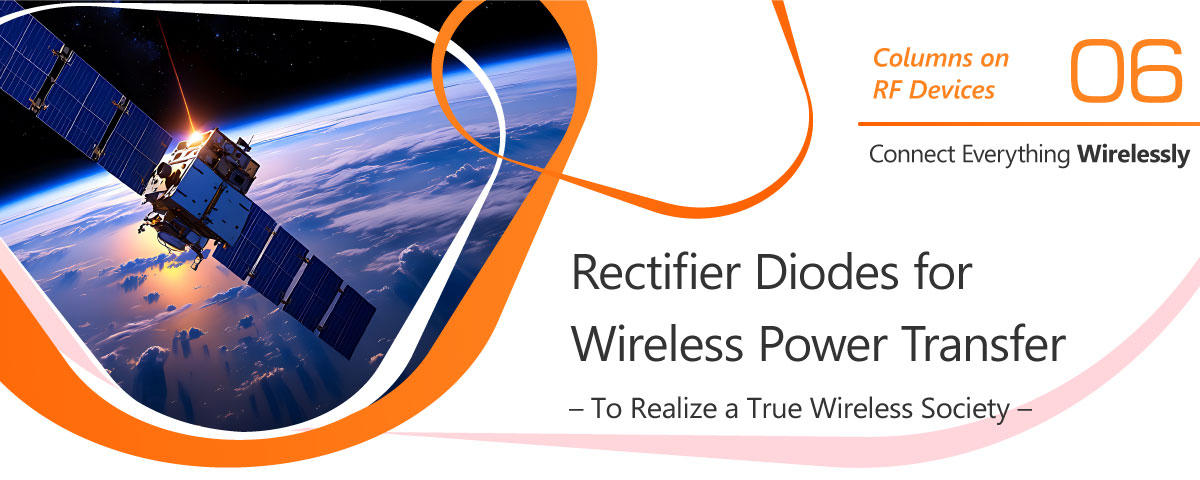
Truly Wireless
Today, we have a wide variety of wireless devices. However, there remains one extremely inconvenient cable that continues to plague everyone. That is the power cable. To charge batteries, this cable is still indispensable.
There are already contact-type (proximity-type) wireless charging devices, often called “just-place-and-charge,” but a cable still exists between the power outlet and the charging device. If this cable were eliminated, wouldn't that be considered “truly wireless”?
The technology that eliminates the need for this power cable is called wireless power transfer (WPT). Far-field WPT can deliver electricity over distances of 5 meters or more.

To transmit electricity over long distances, we utilize the power of radio waves. Radio waves, as you know from TV, cell phones, and Wi-Fi, can send signals over long distances. Microwave ovens also use radio waves (microwaves) inside their boxes to heat food. Far-field WPT is another application of these radio waves.
In fact, research institutions such as universities and manufacturers have been actively engaged in the research and development of this far-field WPT technology for some time.
In Japan, the Radio Law (Act on the Use of Radio Waves) was partially revised in 2022, enabling the use of radio waves for WPT.
While radio waves are not yet at a level usable for charging smartphones due to numerous regulations, accumulation of practical results will likely facilitate the law amendment to make your lives more convenient. I hope that in the future, we aim to contribute to the realization of a truly wireless era where smartphones charge simply by being placed anywhere in a room.



Future Home Applications of WPT
Far-field Wireless Power Transmission (Microwave WPT)
Far-field WPT is also called microwave WPT, as it utilizes radio waves (microwaves).
The device that generates and transmits these microwaves is called a transmitter, and the device that converts microwaves into direct current power is called a receiver. It's like the relationship between a mobile phone base station and a terminal such as a smartphone.
This transmitter consists of a circuit that generates and amplifies microwaves and an antenna that radiates the microwaves into the air.
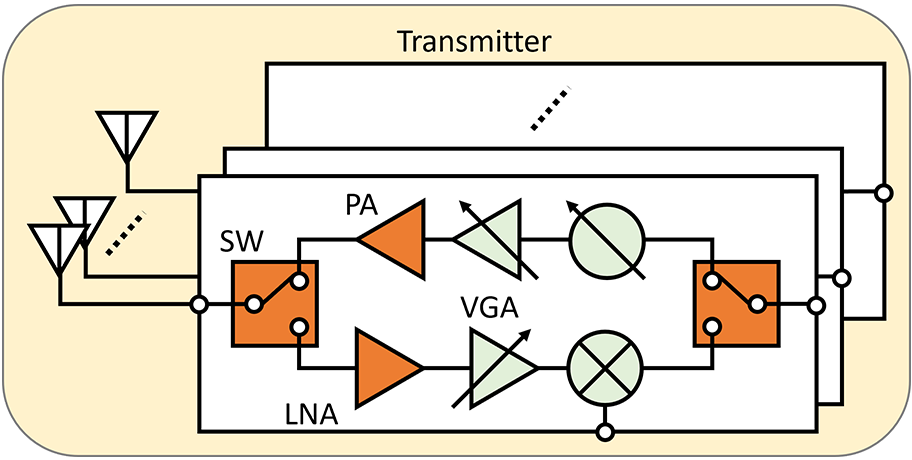
Block Diagram of A Transmitter
Microwaves radiated from transmitters tend to spread out in the air. This causes power dispersion, and by the time the microwaves reach the receiver, the transmitted power can sometimes be reduced to about one-hundredth of its original amount.
To improve this, arranging multiple antennas allows for the transmission of greater power. Furthermore, it enables control (beamforming) to radiate microwaves only in the desired direction. This beamforming technology is also used in 5G mobile phones and Wi-Fi 6E.
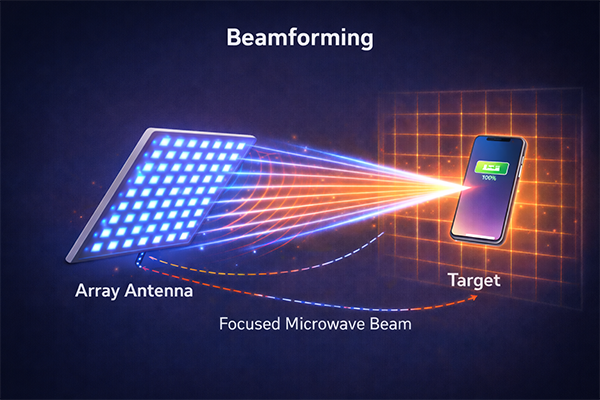
Beamforming
On the other hand, the receiver consists of an antenna that receives microwaves, a rectifier circuit that converts the received microwaves into direct current power, and a DC-DC converter that stabilizes the voltage of this direct current power for charging batteries or similar devices. The antenna and rectifier circuit are sometimes collectively referred to as a rectenna.
The receiver must convert incoming microwaves into DC power with minimal loss. The ratio of the extracted DC power to the input power ((Vout × Iout) / Pin) is called the rectification efficiency (η). Higher rectification efficiency yields greater power output, enabling faster charging of connected devices. Furthermore, lower losses result in reduced heat generation.
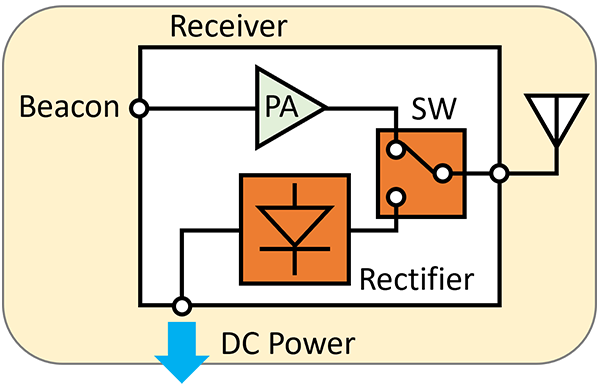
Block Diagram of a Rectenna
Under Japan's current Radio Law, WPT frequencies permitted are the 920 MHz band, 2.4 GHz band, and 5.7 GHz band. Under current regulations, the 920 MHz band permits transmission power of 1 W or less, but its use is allowed in indoor environments where people are present. Conversely, the 2.4 GHz and 5.7 GHz bands permit transmission of higher power levels, but their use is restricted to indoor environments without people.
Nisshinbo Micro Devices is conducting research and development of the following components for microwave WPT:
- High-efficiency power amplifiers (PAs) optimal for use in beamforming transmitters
- Rectifiers for receivers
- Rectenna modules for receivers
- DC-DC converters for receivers
Here, we will explain the rectifiers for receivers.
Development of WPT Rectifier
We have been conducting joint research with the Kenji Ito Lab at Kanazawa Institute of Technology since 2023. The Ito Lab has achieved the world's highest efficiency in 5.7 GHz band rectifiers through past research and possesses extensive design expertise in rectifiers and antennas.
As we have our longstanding expertise in manufacturing GaAs devices, we can develop GaAs devices ideally suited for this rectifier. Believing that combining our strengths will enable us to create the optimal rectifier for WPT receivers, we initiated this joint research.
The device required for the rectifier is a diode. The diode performance required for the WPT rectifier is as follows.
- Low forward voltage (Vf) ... Can rectify even low-power microwaves
- High reverse breakdown voltage (Vbr) ... Withstands high-power microwaves without damage
- Low parasitic capacitance (CT) ... High performance even at high frequencies
Until now, diodes developed specifically for WPT have been virtually unavailable from semiconductor manufacturers worldwide.
-
Here is a brief introduction of our WPT rectifier diode.
This configuration is based on the GaAs HJFET (pHEMT) introduced in Column 2, forming a diode (gated anode diode) by connecting the FET's drain and gate. Since it originates from an FET, we can utilize the FET manufacturing technology we employ to produce many of our products.
Our HJFET allows adjustment of the gate voltage that blocks current flow between drain and source, known as the threshold voltage (Vth). By adjusting this threshold voltage (Vth) to near 0 V, it is possible to create a highly sensitive diode where forward current rises from nearly 0 V.
-
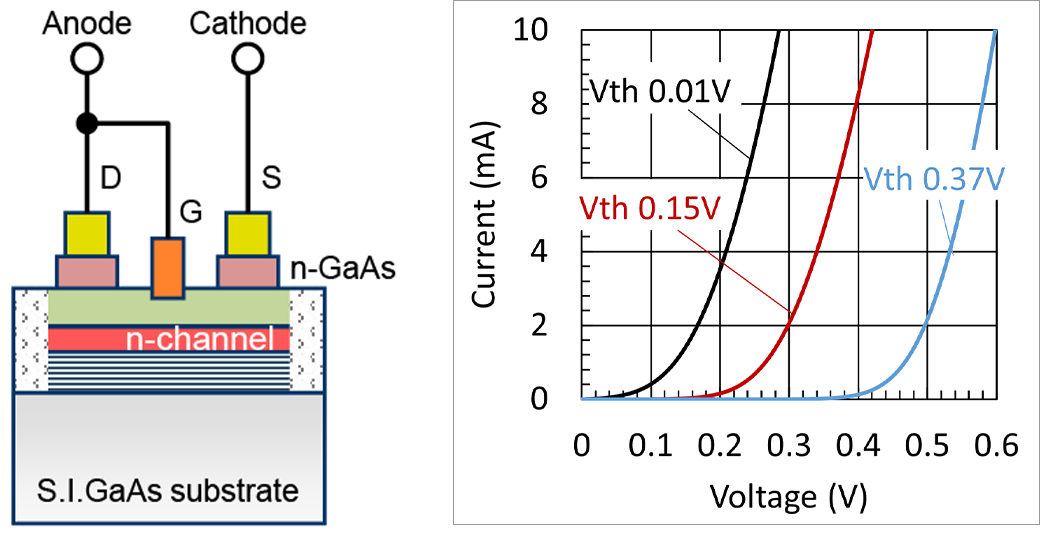
Brief Illustration and Characteristics of Our GaAs Gated Anode Diode
Furthermore, HJFETs can achieve high breakdown voltages exceeding 20 V. This enables the realization of diodes that remain intact when subjected to large power inputs. Additionally, GaAs HJFETs inherently possess lower parasitic capacitance compared to Si, making them well-suited for high frequencies. They can achieve sufficient performance even in the 5.7 GHz band permitted for use under the current Radio Law in Japan.
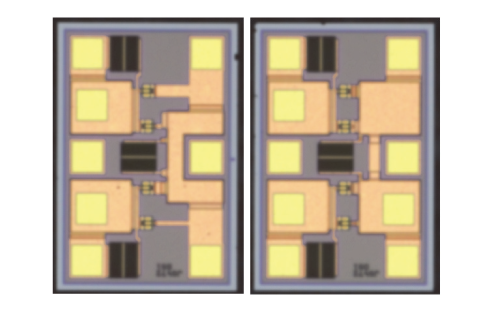
As explained above, using diodes manufactured with our GaAs technology enables the realization of rectifier circuits optimized for WPT. Combining this technology with Kanazawa Institute of Technology's rectenna design expertise, we prototyped the following two rectifier ICs.
- 5.7 GHz band 1-5 W Rectifier
- 920 MHz band 1 mW Rectifier
The research results from this time are also published in our company's web release article, so please refer to that. Simply put, thanks to the diodes with the low threshold voltage and high reverse breakdown voltage described earlier, we were able to realize a rectifier with a wider dynamic range (usable power range) than conventional ones.
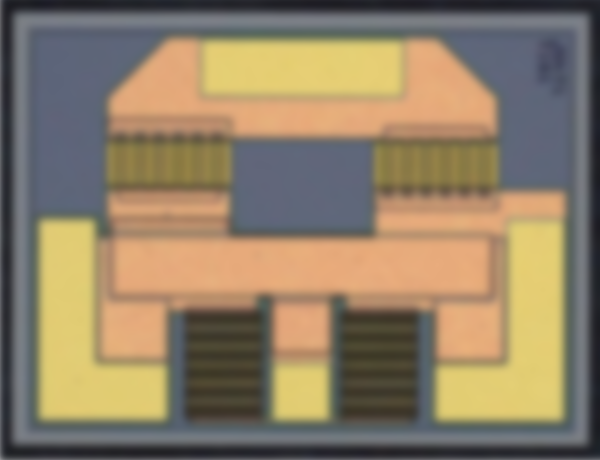
Prototype of Rectifier Chip
These research findings have been presented jointly with Kanazawa Institute of Technology at the following academic conferences and events.
- The Institute of Electronics, Information, and Communication Engineers (IEICE) General Conference 2024, Hiroshima (March 2024, Hiroshima University) [1] [2]
- The Technical Committee on Microwaves, The Electronics Society, IEICE (February and April 2024) [3] [4]
- - IEEE Wireless Power Technology Conference and Expo (WPTCE) 2024 (May 2024, Kyoto University) [5] [6]
For the Spread of WPT and Development of Diodes
Spreading microwave WPT is confronted with many challenges including legal frameworks. One challenge is that there are no mass-produced diodes or rectifier ICs optimized for WPT. This is why we decided to mass-produce diodes optimized for WPT to make WPT adopted worldwide.
Our company has developed the rectifier ICs mentioned above, but we judge that few manufacturers are using the rectifier ICs as-is, as many are still experimenting with various forms of rectifier circuits. Therefore, we decided to discretize the diode portion of the rectifier IC for mass production.
-
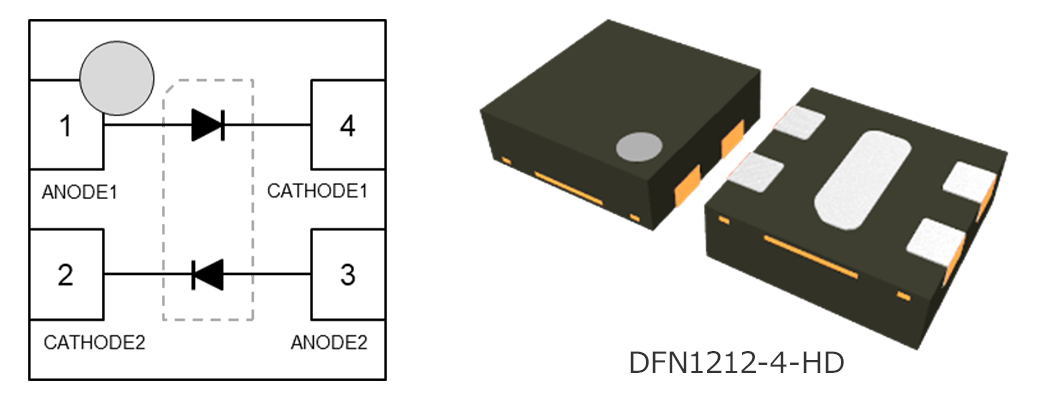
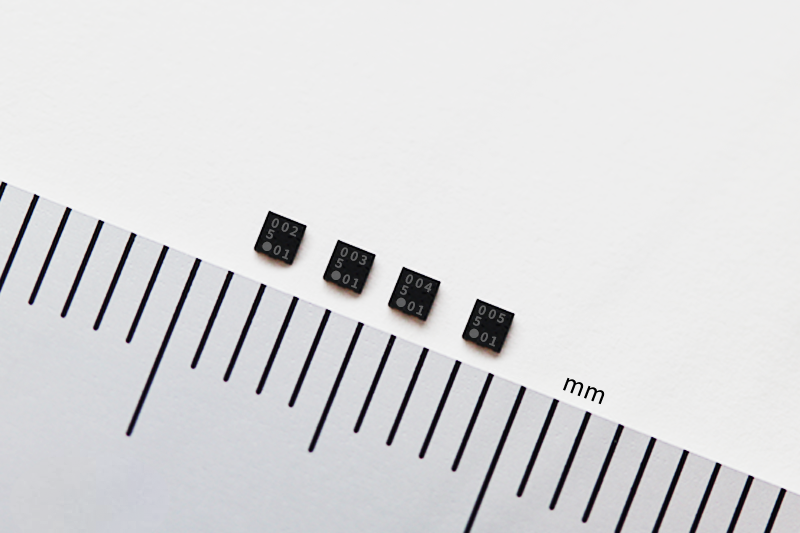
Block Diagram and Outline Image of NT9000HDAE4S -
The chip consists of a pair of discrete diodes with alternating anode and cathode orientations and is sealed in a resin package. To prioritize ease of use over size, a 4-pin package of a terminal pitch of 0.5 mm is adopted.
Four types of diodes are prepared in total: two for 1-W-class rectifiers and the others for 1-mW-class rectifiers, which allows users to consider using rectifiers in various applications.
We provide total support by preparing SPICE models and application notes necessary to design rectifier circuits using these diodes.
One of our research findings includes rectennas achieving high performance without an input matching circuit, by directly matching the impedances of a rectifier circuit and antenna. [7]
These discrete diodes enable various rectifier circuits and are also available for use in radio frequency circuits other than WPT.
As one of the few GaAs manufacturers, we intend to continue our research and development to meet future demands for miniaturization and higher performance, aiming to contribute to the advancement of WPT.
Future of WPT
Microwave WPT has the characteristic of being able to transmit power over long distances. Therefore, it is expected to expand into various new applications beyond the charging of electronic devices mentioned at the outset.
- Power transmission to remote islands or areas where installing power lines is difficult, such as between islands or during disasters
- Realizing drones that can fly continuously by powering aerial vehicles, eliminating the need for landing to recharge
- Space solar power systems (SSPS) that generate electricity via satellites and transmit it to Earth
- Space development applications, such as power transmission from solar power stations installed in space or on the lunar surface to space-based equipment


Among these, SSPS is one field actively researched in Japan, primarily by JAXA (Japan Aerospace Exploration Agency). As a clean energy source with zero CO2 emissions during power generation, it holds promise as a future renewable energy source capable of addressing various challenges currently faced by terrestrial power plants, such as global warming and environmental pollution.
Our WPT rectifier technology is not yet ready for immediate use in SSPS, but we will continue steady research and development to contribute to future technological advancements.

Continued in Volume 7
Published Mar. 10, 2026
- [1] Gaku Kato, Takamasa Kono, Yuya Hirose, Naoki Sakai, Kenji Itoh “Expanding the dynamic range of rectifier MMIC by changing the threshold of GaAs GAD” 2024 IEICE General Conference, Hiroshima, Japan, March 2024, C-2A-33
- [2] Taiki Hirase, Yuya Hirose, Tsukasa Hirai, Gaku Kato, Takamasa Kono, Naoki Sakai, Kenji Itoh “High dynamic range 920MHz band rectennas with the low threshold voltage GaAs GAD” 2024 IEICE General Conference, Hiroshima, Japan, March 2024, C-2A-38
- [3] Taiki Hirase, Yuya Hirose, Tsukasa Hirai, Gaku Kato, Takamasa Kono, Naoki Sakai, Kenji Itoh, “High Dynamic Range 920 MHz Band Low Power Rectenna with Low Threshold Voltage GaAs GADs” IEICE Technical Report MW2023-179(2024-02) pp.25-29
- [4] Yuya Hirose, Gaku Kato, Takamasa Kono, Naoki Sakai, Kenji Itoh “A high-dynamic range 5.8GHz band 1W rectifier MMIC with low threshold voltage GaAs GADs” IEICE Technical Report WPT2024-1, MW2024-4(2024-04) pp.18-24
- [5] Yuya Hirose, Gaku Kato, Takamasa Kono, Naoki Sakai, Kenji Itoh “A High-Dynamic Range 5.8 GHz Band 1 W Rectifier MMIC With Low Threshold Voltage GaAs GADs“ 2024 IEEE WPTCE, Kyoto, Japan, 2024, pp.861-864
- [6] Taiki Hirase, Yuya Hirose, Tsukasa Hirai, Gaku Kato, Takamasa Kono, Naoki Sakai, Kenji Itoh “High Dynamic Range 920 MHz Band Low Power Rectenna with Low Threshold Voltage GaAs GADs” 2024 IEEE WPTCE, Kyoto, Japan, 2024, pp.865-868
- [7] Naoki Sakai, Kenji Itoh “Design Methodology on 920MHz Band Low Power Rectennas for Beginners” MWE2025, Yokohama, Japan, November 2025, TH4B-3
Authors' Profile
-

Gaku Kato
Contributing to designing RF devices for over 20 years, including the development of the LNA achieving industry-leading low noise figure. With his motto "flexible product development that pleases customers," he devotes himself to creating prominent products. The representative of these columns.
Columns on RF Devices
Connect Everything Wirelessly
-
Rectifier Diodes for Wireless Power Transfer – To Realize a True Wireless Society –
-
RF Switch (Radio Frequency Switch) – Transmit RF signals as They Are –
-
Power Amplifier: The Key Device for Communication Applications
-
History of Our GaAs Semiconductor Products -History? Of Course There Is- (Latter Half)
-
History of Our GaAs Semiconductor Products -History? Of Course There Is- (Former Half)
-
Introduction: What Is a GaAs Semiconductor?
RF Device Related Information
Find Products
FAQ
- Are there any cases where DC blocking capacitors are required for RF switches not needing DC blocking capacitors connected to the RF terminals?
- I could not get the NF measurement value according to the datasheet. Please let us know how to resolve about this.
- Do you have low noise amplifiers (LNAs) for GNSS 1.2GHz band (L5/2/6 band)?
- In automotive GNSS, receiver sensitivity is degraded due to high cable losses in roof antenna applications. To compensate for this degradation, do you have a high-gain low noise amplifier for GNSS?
- Does latch-up occur in GaAs products?