






Nisshinbo Micro Devices Expands High-Voltage IC Lineup for Next-Gen Automotive 48 V Systems
Leveraging our expertise in 12 V systems
The transition from 12 V to 48 V automotive power supply systems is gaining momentum; consequently, challenges specific to 48 V systems have emerged in terms of power supply design. Leveraging the expertise acquired in 12 V systems, Nisshinbo Micro Devices is intensifying its efforts to roll out solutions that address the challenges of 48 V system power supplies. Rather than simply providing individual power supply ICs, the company offers comprehensive assistance in the transition to 48 V systems, including custom design services and a wide range of support options.
48 V power supply systems: many advantages and a few new challenges
The automotive industry is currently experiencing a once-in-a-century transformation. Driven by the acceleration of software-defined vehicle (SDV) development and the evolution of advanced driver-assistance systems (ADAS), the electrification and automation of in-vehicle systems are advancing rapidly. Because this transformation leads to an increase in the power supply required for electrical components, the shift from conventional 12 V automotive power supply systems to 48 V systems is accelerating.
48 V systems offer many advantages. If the power supplied remains the same, increasing the voltage fourfold from 12 V to 48 V reduces the current flow to one-fourth. This not only minimizes current loss, which is proportional to the current, but also allows for the use of thinner harnesses, significantly reducing the weight of the wiring.
On the other hand, 48 V systems present unique challenges in the design of power systems. These include heat and noise management, coexistence with 400 V/800 V high-voltage battery systems, and addressing module size constraints. Based on the expertise and technology acquired by working on 12 V systems, Nisshinbo Micro Devices is strengthening its lineup of power supply products to help resolve the challenges presented by 48 V systems.
As heat loss emerges as a prominent issue, replacing LDOs with DC/DC converters is becoming more common
The first consideration in thermal design is the significant heat loss that occurs when using low-dropout linear regulators (LDOs) for voltage conversion in 48 V systems. While LDOs produce little noise, they inherently generate a great deal of heat. Although this is not a particular problem in 12 V systems, heat loss due to heat generation may exceed the allowable limit in 48 V systems, where the input voltage is higher. If this happens, there’s a risk that reliability will decrease.
As reported by Nisshinbo Micro Devices, DC/DC converters have become a viable alternative to LDOs in the output current range of 20 mA to 100 mA or so. In 12 V systems, LDOs can supply up to 100 mA to drive microcontrollers and other components. However, thermal issues become significant in 48 V systems, and in practice, such systems can only supply around 20 mA. Currently, the drive current for microcontrollers is also trending upward, which makes it difficult to continue using LDOs in this range.
Shigeki Kajitani, automotive business manager at Nisshinbo Micro Devices, adds that “automakers view this range as a current challenge. There is also a high level of interest from Tier 1 suppliers.”
This, however, does not mean that demand for LDOs will decrease. “While replacing LDOs with DC/DC converters is effective for step-down conversion from 48 V, certain automotive systems require further step-down conversion from 12 V to supply power to devices. For these secondary power supply applications, demand for LDOs remains high,” says Kajitani.
Nisshinbo Micro Devices offers a full lineup of power supply solutions compatible with 48 V systems, including LDOs for automotive secondary power supplies.
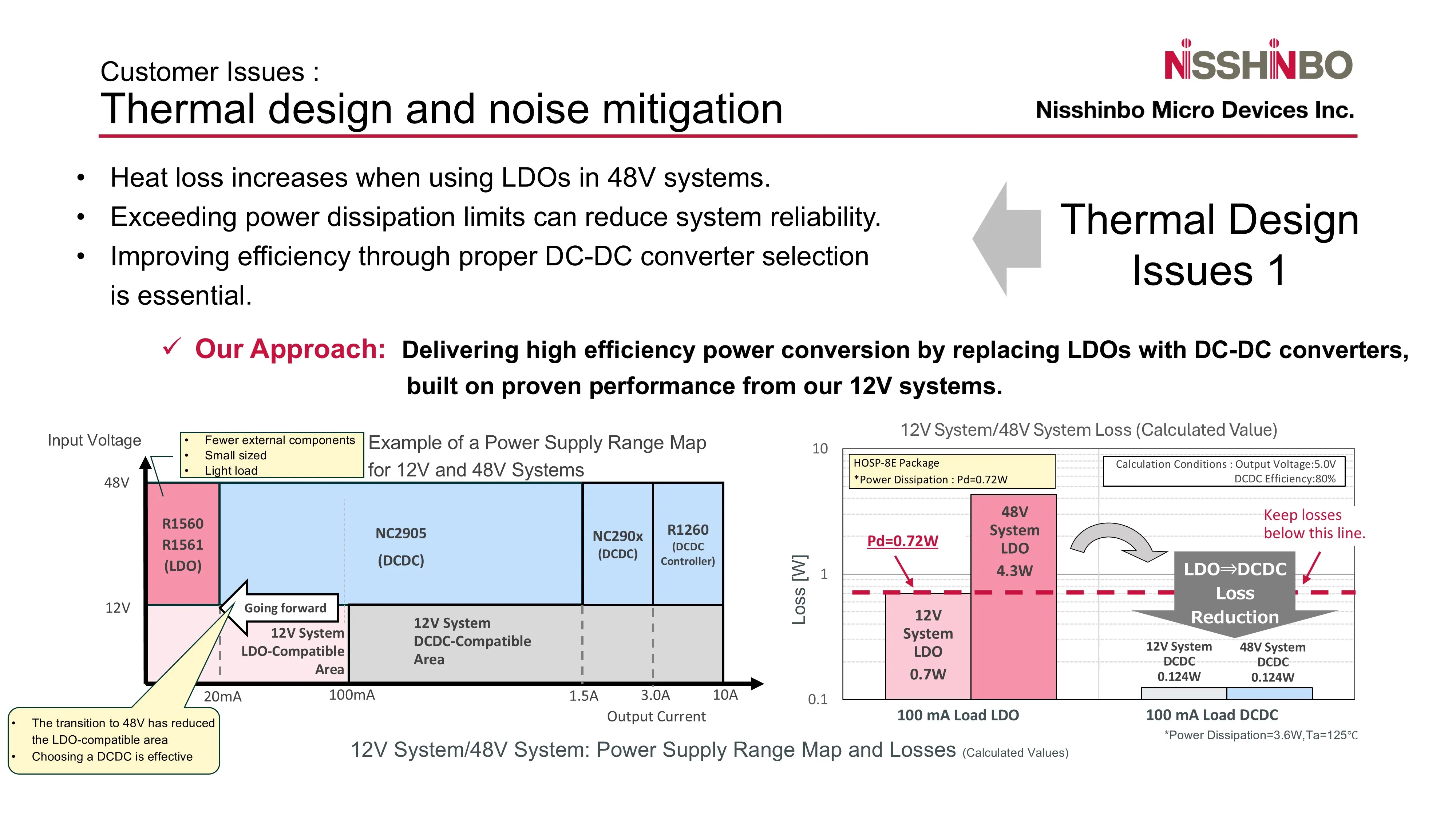
As shown in the figure on the left, LDO regulators are increasingly being replaced by DC/DC converters in the 20 mA to 100 mA output current range, which results in lower power loss. (Courtesy of Nisshinbo Micro Devices)
Combining low noise levels with low power consumption

Shigeki Kajitani, Automotive Business Manager, Nisshinbo Micro Devices Inc.
Alongside heat loss, noise is another major challenge. The switching voltage increases in 48 V systems, which inevitably leads to higher noise levels. Since this raises the risk of malfunctions in the equipment and system, the selection of a power supply with high noise immunity is essential. At the same time, low power consumption during standby is also a requirement due to the very strong demand for low power consumption to reduce the power consumption of in-vehicle systems while parked.
However, high noise immunity and low current consumption are conflicting requirements. From a circuit design perspective, increasing the current makes it easier to suppress noise. Kajitani emphasizes that designing power supplies that balance these trade-offs requires expertise, and that is precisely where Nisshinbo Micro Devices excels. For example, the 12 V compatible LDO R1525 achieves high immunity of 33 dBm while maintaining a low current consumption of 2.2 μA (typical). For 48 V applications, the company offers the high-voltage LDOs R1560 and R1561, which inherit the strengths of the R1525 and combine high immunity with low current consumption.
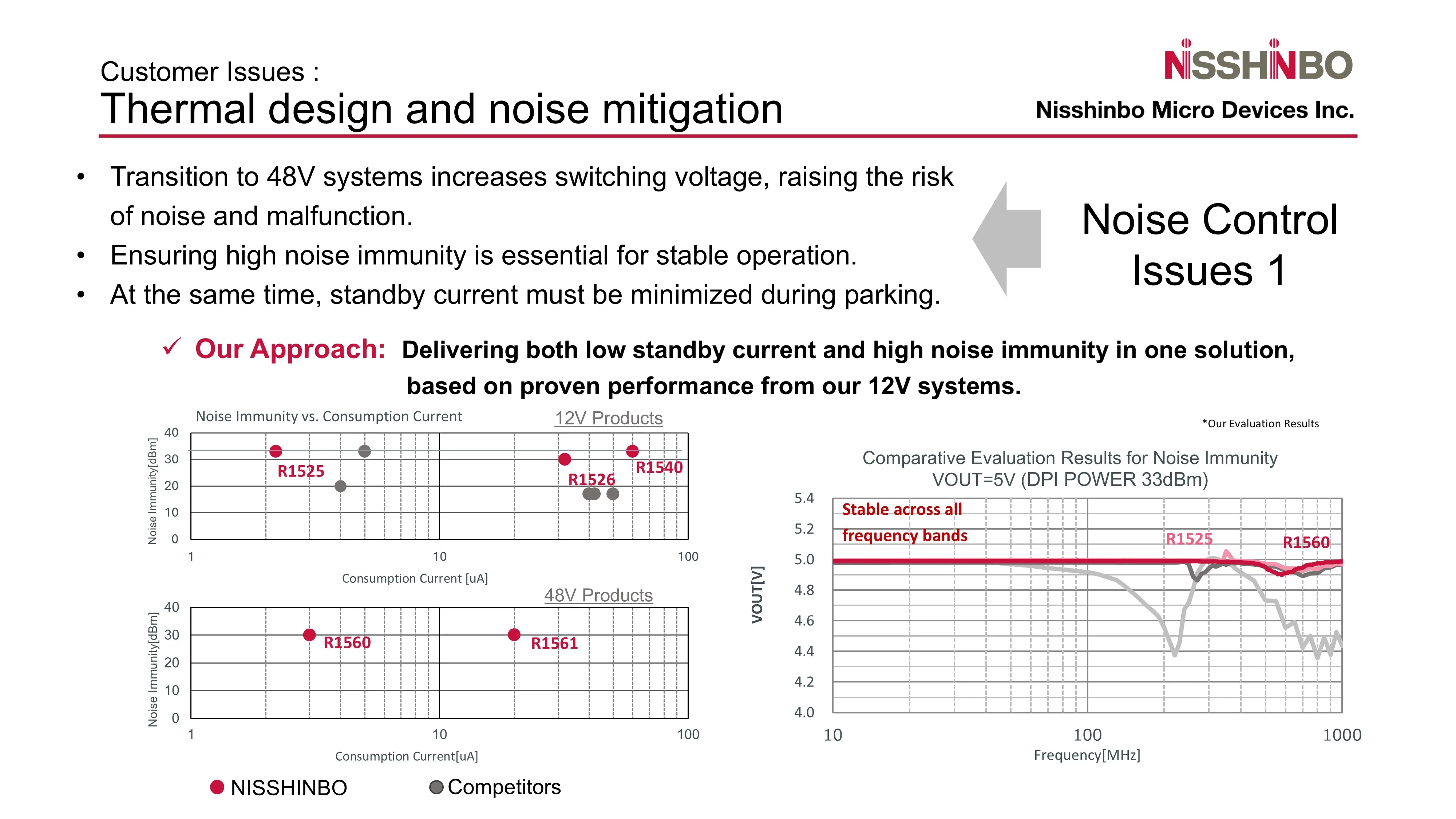
Nisshinbo Micro Devices’ LDOs combine noise immunity and low current consumption. (Courtesy of Nisshinbo Micro Devices)
In terms of noise, it is important not only to ensure noise immunity but also to minimize emissions. The R1260 step-down DC/DC controller features an 80 V voltage rating and minimizes noise through a spread-spectrum function. In particular, the unit suppresses noise in the AM and FM bands while achieving CISPR 25 Class 5 compliance in noise tests.
“It is difficult to suppress noise to this extent with an IC alone; low emissions can be achieved only in conjunction with the appropriate selection of peripheral components and the PCB layout. We can provide comprehensive support that includes these aspects as well,” says Kajitani. In addition, the R1260 boasts high conversion efficiency under light loads. By automatically switching between VFM mode and PWM mode, depending on the load current, the unit achieves high efficiency of over 90% even at currents of 10 mA or less, as reported by Nisshinbo Micro Devices.
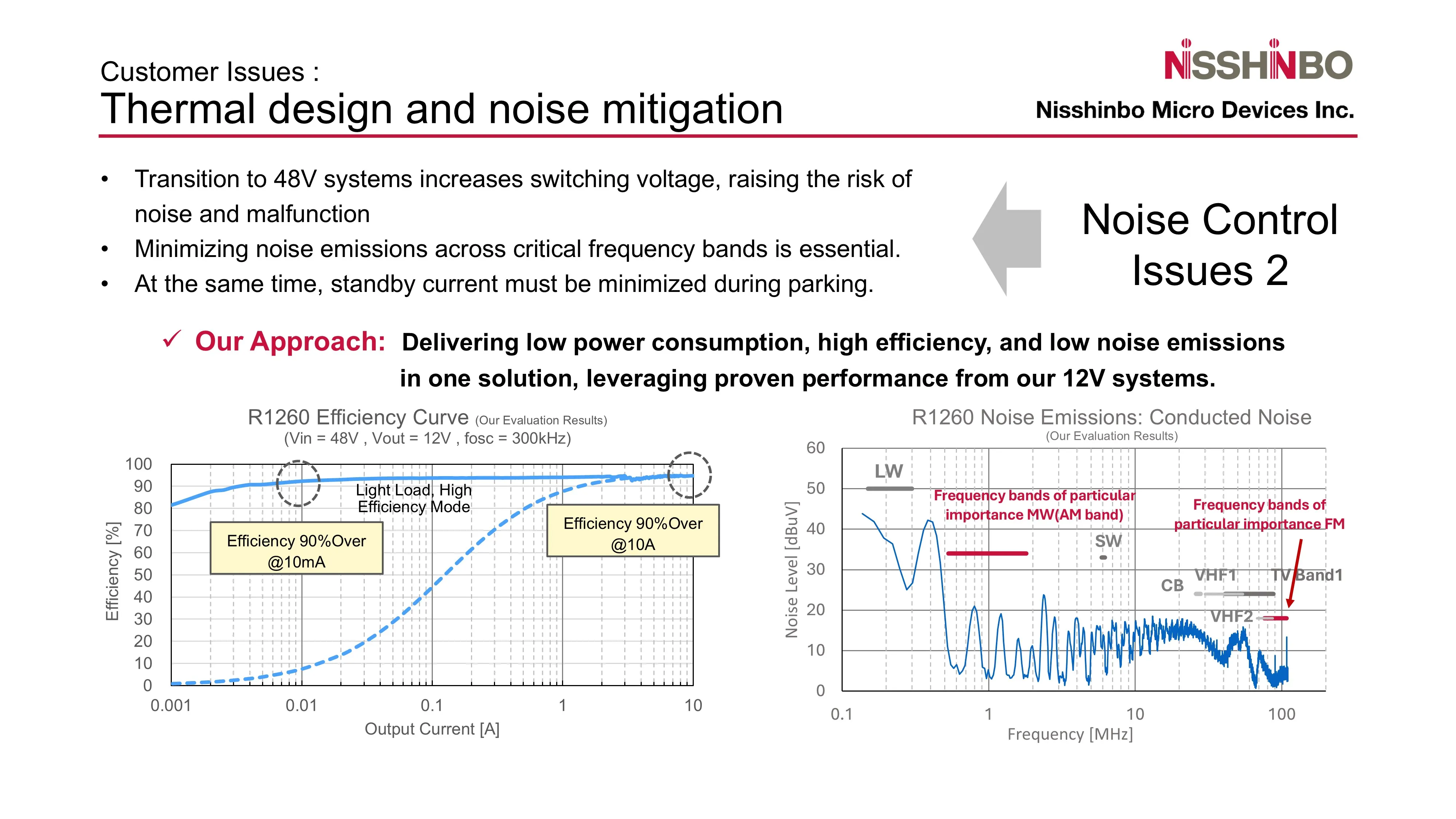
Efficiency under light loads (left) and emissions in the AM and FM bands (right) for the R1260 step-down DC/DC controller. (Courtesy of Nisshinbo Micro Devices)
Addressing size constraints with single-chip technology
The method of addressing size constraints is crucial. The batteries installed in battery electric vehicles (BEVs) are quite large; therefore, they impose constraints on vehicle space and weight. Power control units must also be mounted in tight spaces. As reported by Nisshinbo Micro Devices, what is expected of the company is to propose power ICs that integrate power components and, by including surrounding passive components, are compact and lightweight. The company provides optimal PMICs and ASSPs tailored to customer needs.
Kajitani says, “We possess a wide range of intellectual properties (IP) and specialize in single-chip integration technology that encompasses analog and power circuits as well as digital components. Our ability to propose power supply optimization at the system level is one of our biggest strengths.”
Isolated power supplies enable coexistence with high-voltage systems
In BEVs, high-voltage systems (400 V/800 V) for the drive battery must coexist with low-voltage systems (12 V/48 V) for the auxiliary battery. Therefore, designing the two so that they are isolated is essential. Furthermore, a fail-safe function is required to ensure that the vehicle can safely pull over to the shoulder in the event of a malfunction in the auxiliary battery system that powers in-vehicle ECUs, sensors, and other components. Consequently, generating voltage from the drive battery for the auxiliary system is necessary to ensure that power is supplied to the electrical components. Nisshinbo Micro Devices is focusing on the development of high-voltage-rated isolated power supplies, such as isolated gate drivers and isolated high-voltage monitor ICs, as a product group that bridges high-voltage and low-voltage systems.
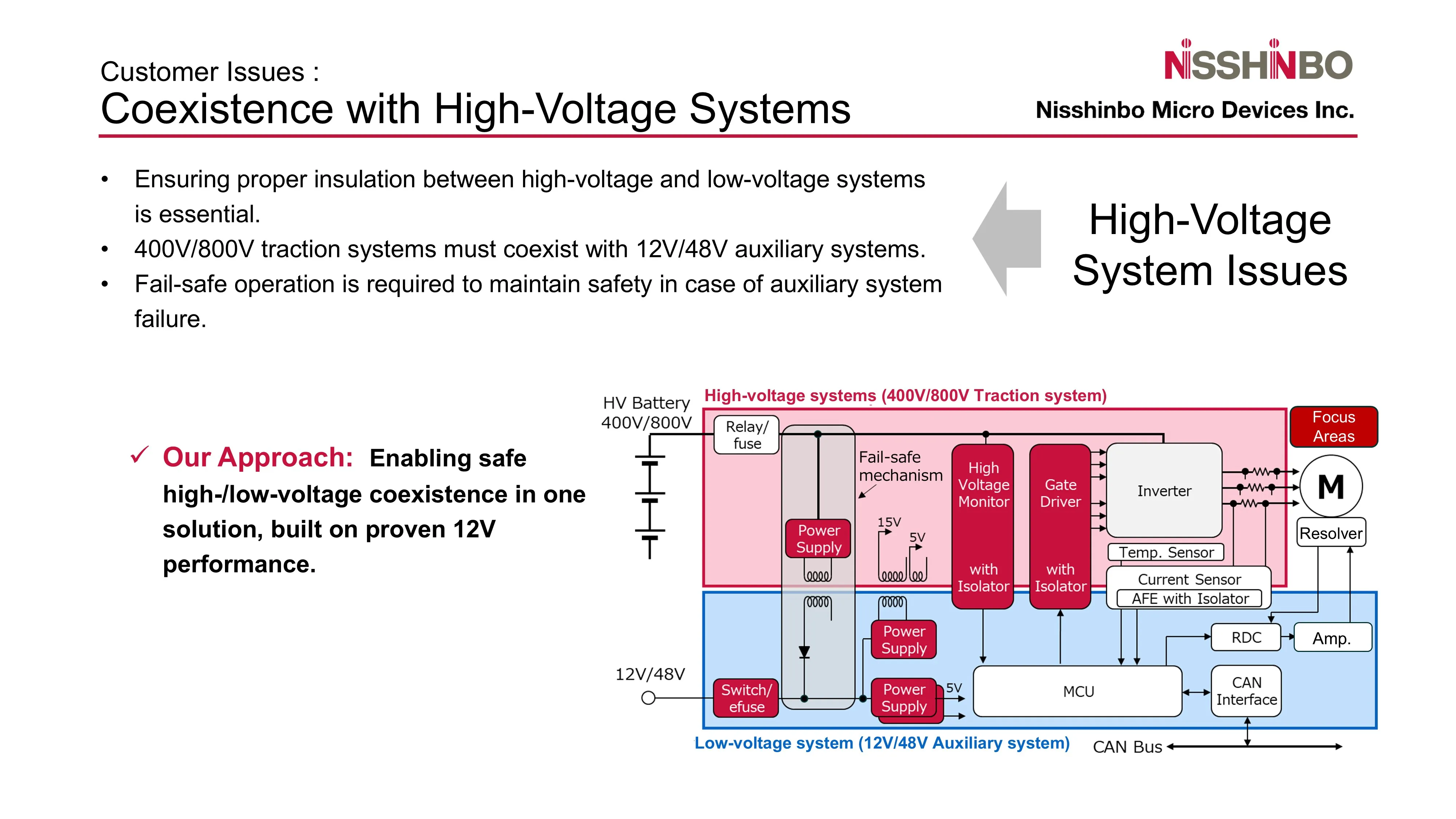
Coexistence of high-voltage and low-voltage systems. (Courtesy of Nisshinbo Micro Devices)
Extensive support system and emphasis on customer dialogues
Another hallmark of Nisshinbo Micro Devices is its comprehensive support system. In addition to in-person assistance, the company offers a wide range of support options, both online and offline, including semiconductor package information, quality and reliability test data, circuit module downloads, and introductory courses (via blogs and videos) on such topics as power supply ICs and operational amplifiers.
Nisshinbo Micro Devices places particular emphasis on dialogues with customers. Leveraging the strengths unique to a vertically integrated device manufacturer, the company consistently engages in discussions with customers, sometimes involving layout and process engineers. “It is only by deepening these dialogues that we can propose power supply solutions best suited to our customers’ needs,” emphasizes Kajitani.
For Nisshinbo Micro Devices, which has extensive expertise in 12 V systems, the transition to 48 V systems represents a major opportunity to expand the automotive business. Nisshinbo Micro Devices is strengthening its automotive business along three axes: expanding its lineup of general-purpose products, such as LDOs and operational amplifiers; developing ASICs and ASSPs; and strengthening its contract manufacturing business. The company plans to increase the proportion of automotive sales to more than 50% of its total revenue by 2035.
“Development of 48 V systems has taken off rapidly over the past five years. The shift to 48 V in the automotive industry is unstoppable,” explains Kajitani. Nisshinbo Micro Devices is poised to become a powerful partner in the selection of power supply solutions for 48 V systems based on its deep expertise and extensive experience in power supply technology for 12 V systems.
To learn more or get design support, visit Nisshinbo Micro Devices.
This article was first published in EE Times on July 20, 2026, and is reprinted here with permission from AspenCore, Inc.
Product Details and Datasheets

Expanding Business Scope
A Compilation of Nisshinbo Micro Devices Interviews
-
Nisshinbo Micro Devices Expands High-Voltage IC Lineup for Next-Gen Automotive 48 V Systems
-
The NA1150 audio amplifier sets a new standard, driving speakers with PWM
-
Introducing definitive industrial sensor AFE ICs by Nisshinbo Micro Devices
-
Actively investing to establish a third pillar of revenues alongside op-amps and power ICs
-
Why Nisshinbo Micro Devices is Expanding ASIC/ASSP Business in Europe
Latest News Highlights
-
New Release of the NT1741, an Ultra-Low-Current Rx Booster Achieving Improved Receiver Sensitivity and Extended Battery Life for Compact Wireless Devices such as Hearing Aids
-
The world’s first technology 'Silicon Motherboard'
Circuits are formed on both sides of the silicon substrate, reducing mounting footprint by 80%
What is myNISD?
myNISD offers a variety of services, including electronic device inquiries, SPICE model downloads, Prime Designer simulations, and on-demand videos.