







Environmental Initiatives Environment
Energy-Saving Activities
Energy Saving through Inverter Control of Cooling Water Pumps for Production Equipment
Energy-Saving Activities
At the Kawagoe Plant of Nisshinbo Micro Devices Inc., we operate four units of water supply pumps for indirect cooling water used in production equipment installed in clean rooms. Until now, when an abnormal shutdown or sudden pressure drop occurred in a pump, we adjusted the pressure using valves and supplied water at a higher-than-normal pressure to prevent any impact on the production equipment. As a result, this practice led to continued consumption of more electricity than necessary.
To address this issue, we switched to a system that adjusts the motor’s rotation speed through inverter control while continuously monitoring the water supply pressure. This change enables stable pressure maintenance and efficient operation, resulting in an estimated annual reduction of approximately 270 MWh in electricity consumption and about 87.0 tons of CO2 emissions.
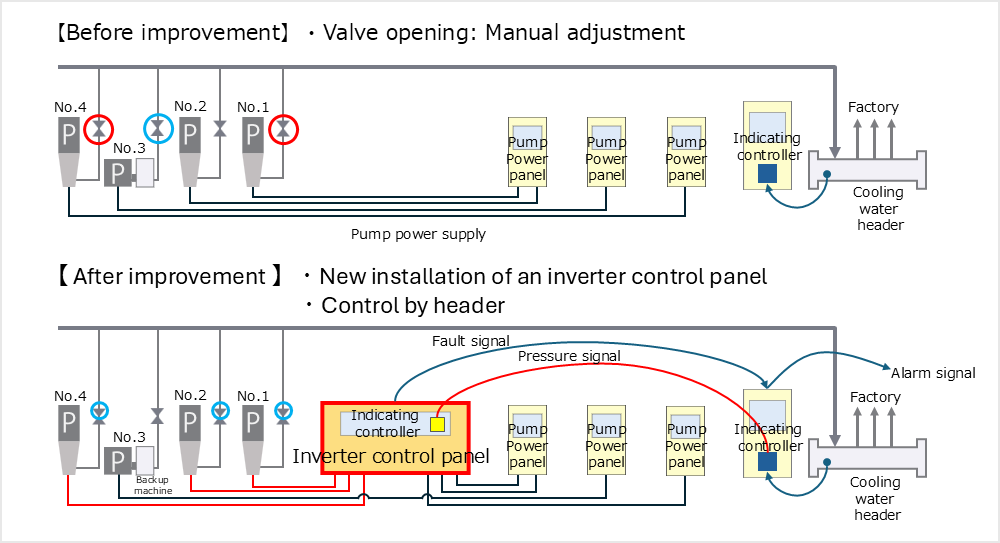
Conversion of cooling water pump to inverter control
Reduction of City Gas Consumption through Changes in Acid Wastewater Treatment Method
Energy-Saving Activities
At the Yashiro Plant of Nisshinbo Micro Devices Inc., acidic wastewater discharged from the production line was treated with steam before being released into the sewer system previously. This treatment method required a large amount of steam to ensure safety during abnormal conditions and to maintain stable wastewater processing, which led to increased consumption of city gas.
The acidic wastewater contained hydrogen peroxide and was mixed with alkaline wastewater for thermal decomposition using steam. However, the volume of acidic wastewater was approximately 2.5 times greater than that of alkaline wastewater, resulting in a proportionally higher amount of steam required for treatment. To improve the efficiency of wastewater treatment and reduce environmental impact, the plant switched to a chemical treatment method for acidic wastewater by separating it from alkaline wastewater.
This improvement significantly reduced steam usage, achieving an annual reduction of approximately 180,000 m3 of city gas. Furthermore, the decrease in steam usage also reduced the amount of water needed for steam generation, resulting in an annual water-saving effect of about 2,000 m3. These initiatives contribute to reducing environmental impact and improving energy efficiency.
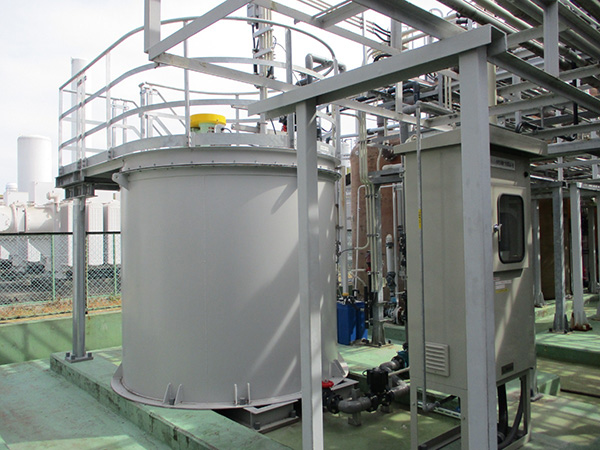
Acid wastewater treatment facility
Reduction of Electricity Consumption in Power and Production Equipment
Energy-Saving Activities
At Nisshinbo Micro Devices Fukuoka Co., Ltd., we set a goal to reduce electricity consumption by more than 1% compared to the previous fiscal year (equivalent to 2.55 MWh annually) and by more than 15% compared to fiscal year 2014 (equivalent to 5,322 MWh annually) by the end of fiscal year 2024. To achieve this, we implemented multiple energy-saving measures for power and production equipment. Specific initiatives included:
- Cooling Water Pump System: Added an inverter control panel to a 37 kW IE3 motor and switched to an operation method that adjusts frequency. This achieved an annual electricity reduction of approximately 79 MWh and a CO2 emission reduction of about 30 tons.
- Pure Water System: When replacing the RO high-pressure pump (No. 2), the 30 kW motor was upgraded to an IE3 motor (Top Runner standard), reducing annual electricity consumption by about 7.5 MWh and CO2 emissions by approximately 2.9 tons.
- Diffusion Furnace Heat Retention: During standby periods, quartz boats were sealed inside the furnace with end caps for 183 days annually. This reduced electricity consumption by about 7.3 MWh and CO2 emissions by approximately 2.8 tons.
- Standby Temperature Adjustment: Reviewed standby temperatures during non-production periods, adjusting diffusion furnace temperatures for equipment with long product wait times. This achieved an annual electricity reduction of approximately 118 MWh and a CO2 emission reduction of about 45 tons.
Additionally, a 21% decrease in production load compared to the previous year allowed us to introduce non-production days, further contributing to electricity savings. As a result of these efforts, total electricity consumption in fiscal year 2024 was 25,477 MWh, representing a 10.0% reduction (2,876 MWh) compared to the previous year and a 27.9% reduction (9,838 MWh) compared to fiscal year 2014. In terms of greenhouse gas emissions, this corresponds to approximately 1,093 tons and 3,738 tons of CO2 reductions, respectively.
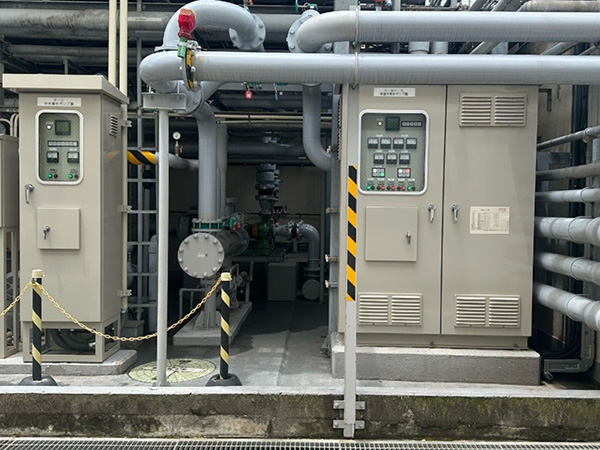
Ambient cooling water pump panel after replacement
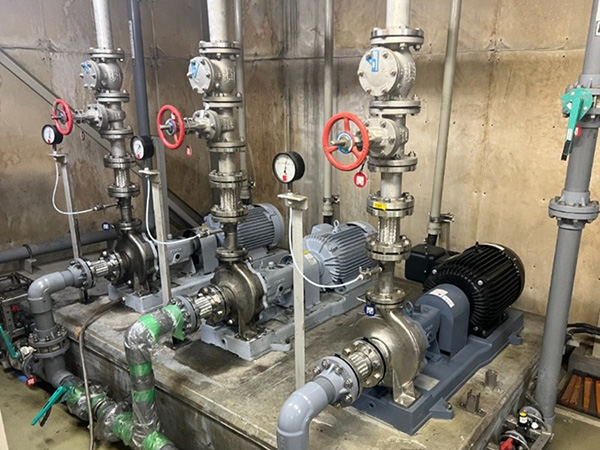
RO high-pressure pump after replacement
Energy-Saving Measures in the Assembly Process
Energy-Saving Activities
At Nisshinbo Micro Devices (Thailand) Co., Ltd., located in the Kingdom of Thailand, we introduced a centralized vacuum pump system to improve energy efficiency in the first IC (Integrated Circuit) assembly process.
Previously, the system relied on 41 small vacuum pumps and 90 vacuum ejectors. These were replaced with three high-efficiency, inverter-controlled centralized vacuum pumps (two under normal operation), significantly enhancing energy efficiency. This equipment upgrade ensured stable vacuum supply while successfully reducing power consumption.
Since the new centralized vacuum system began operation in June 2024, we achieved an electricity reduction of 606 MWh during the second half of the fiscal year, which corresponds to a reduction of 287 tons of CO2 emissions. These results contribute to reducing environmental impact and building a sustainable production system.
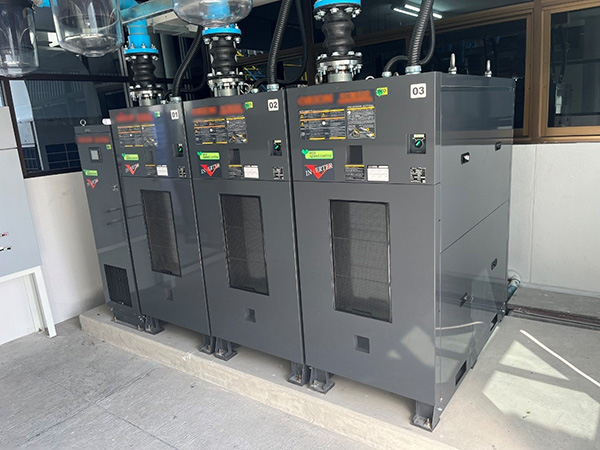
Centralized control vacuum pump
Initiatives to Advance Climate Change Mitigation Efforts
Introduction of Gas Abatement Systems for PFCs and Other Gases
Initiatives to Advance Climate Change Mitigation Efforts
At Nisshinbo Micro Devices Inc., greenhouse gases such as perfluorocarbons (PFCs) are used in the electronic device manufacturing process. Because these gases have a significant impact on global warming, reducing their emissions is considered one of the key challenges in achieving carbon neutrality.
To address this issue, we have been introducing abatement systems to decompose PFC gases. In October 2024, one unit was installed at the Kawagoe Plant, followed by an additional unit at the Yashiro Plant in December.
At the Kawagoe Plant, a combustion-type abatement system was implemented on the exhaust lines of three plasma CVD units that use large amounts of C3F8 gas, which has an especially high global warming potential, which enabled efficient gas decomposition.
Meanwhile, at the Yashiro Plant, to improve processing capacity beyond that of conventional dry-type systems, we adopted a plasma-type abatement system utilizing high-temperature plasma heat of approximately 2,000°C, achieving more advanced decomposition.
These initiatives resulted in significant reductions in greenhouse gas emissions, amounting to approximately 5,880 tons of CO2 equivalent at the Kawagoe Plant and about 3,615 tons at the Yashiro Plant.
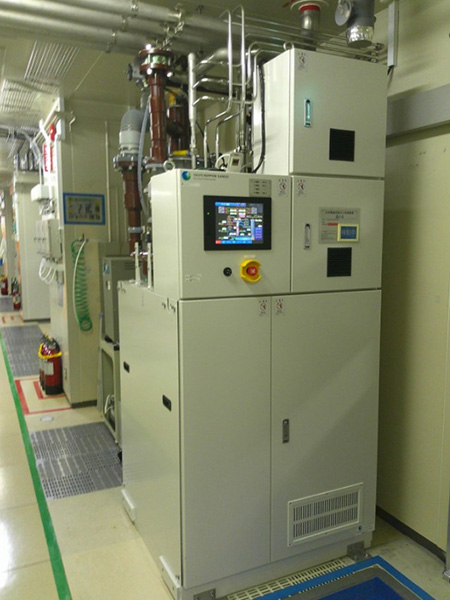
Gas abatement system for PFC and other gases
Water Conservation Initiatives
Effective Utilization of Water Resources through Cooling Water Circulation
Water Conservation Initiatives
At the Kawagoe Plant of Nisshinbo Micro Devices Inc., cooling water for production equipment was previously supplied from well water (groundwater) and discharged outside the plant after use. Under this conventional system, heated cooling water was drained without reuse, resulting in high water consumption and environmental impact.
To address these issues and promote effective use of water resources and environmental conservation, the plant switched to a circulating cooling water supply system that returns wastewater to a storage tank for reuse.
This improvement reduced annual wastewater discharge by approximately 40,000 m3 and significantly curtailed groundwater extraction. In addition, the decrease in pumping volume reduced the electricity required to operate the pumping system, achieving an annual energy-saving effect of about 6,500 kWh. These initiatives directly contribute to water resource conservation and greenhouse gas emission reduction, supporting sustainable production activities.
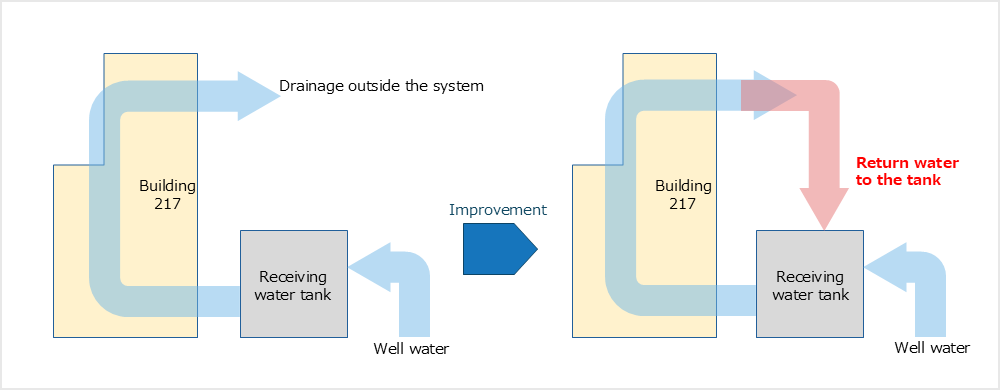
Effective utilization of water resources through cooling water recovery
Reducing Water Usage by Changing Hot Water Control in Outdoor Air Handling Unit Pre-Coils
Water Conservation Initiatives
At the Yashiro Plant of Nisshinbo Micro Devices Inc., we achieved an annual reduction of 536 m3 in water usage by reviewing the control method of the preheating coil installed in the air handling units for the cleanroom.
The preheating coil functions to warm outside air by circulating hot water to prevent the air handling unit from freezing when the outside temperature drops. Previously, once the outside temperature fell below a certain level, hot water continued to flow until the temperature recovered. With the recent improvement, we switched to a control method that monitors the downstream temperature of the preheating coil in real time and adjusts the hot water supply accordingly. This change effectively prevented unnecessary hot water usage.
The reduction in hot water consumption also significantly impacted city gas usage, resulting in an annual reduction of approximately 33,000 m3 of city gas. This initiative not only conserves water resources but also contributes to reducing greenhouse gas emissions by curbing fossil fuel consumption, representing a continued effort by the plant to minimize environmental impact.
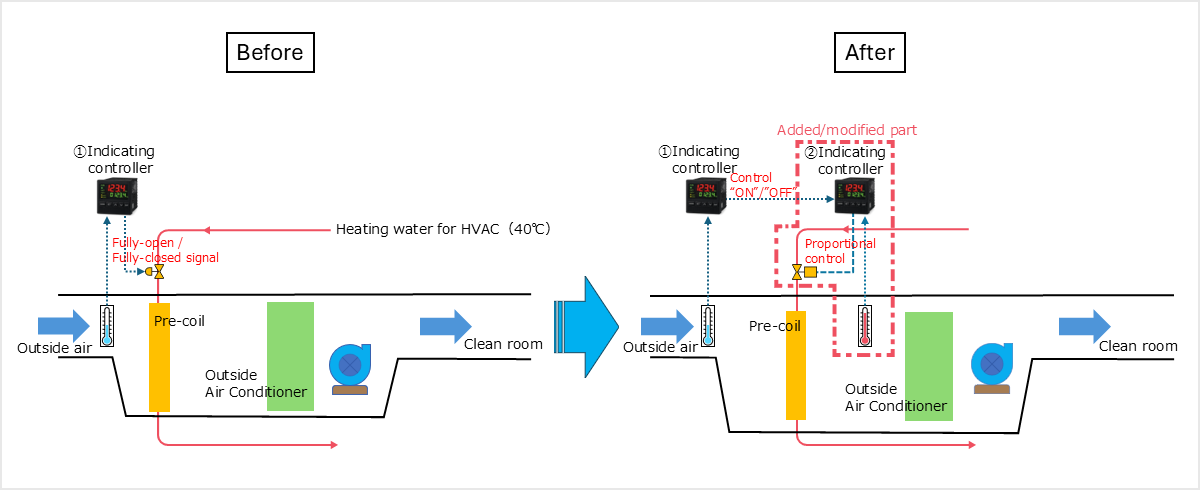
Pre-coil control retrofit

Outside Air Conditioner
Chemical Substance Management
Implementation of Emergency Response Training for Hydrochloric Acid Leakage
Chemical Substance Management
At Nisshinbo Micro Devices AT Co., Ltd., we regularly conduct environmental emergency response drills to prepare for potential leakage incidents at utility facilities, such as heavy oil, chemicals, and acidic or alkaline wastewater. These drills are carried out in collaboration with the Facilities Department and Kyushu Building Service Co., Ltd., which is responsible for utility monitoring operations, and are designed to simulate real emergency situations in a practical manner.
In fiscal year 2024, a drill was conducted based on a scenario in which hydrochloric acid leaked from a level gauge failure in the hydrochloric acid tank used for ion-exchange resin regeneration chemicals in the pure water production system. Hydrochloric acid is highly volatile and generates harmful gases, requiring advanced safety measures during response.
During the drill, participants wore protective equipment such as gas masks with acid absorption canisters, chemical-resistant raincoats, gloves, and boots. As a measure to prevent the spread of leakage, sandbags were used to block nearby drainage channels. Subsequently, workers wearing protective gear closed the valve to stop the leakage. To suppress gas dispersion during valve operation, water was sprayed from upwind using a hose.
After the practical drill, classroom training was conducted on the properties and handling of chemicals, ensuring that all participants deepened their understanding of chemical hazards and appropriate response methods. These initiatives contribute to strengthening the risk management system for both environmental protection and occupational safety.

Emergency response training in progress 1
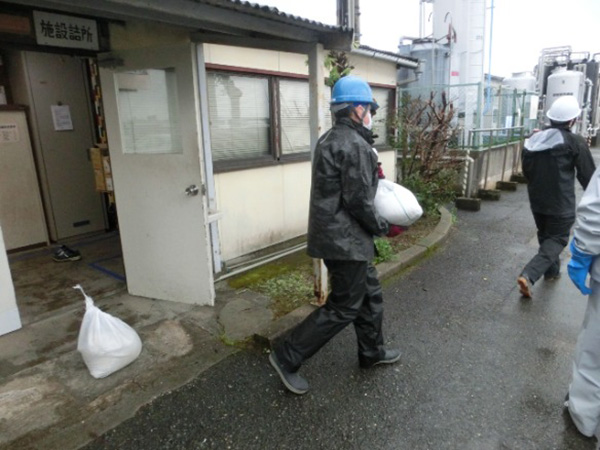
Emergency response training in progress 2